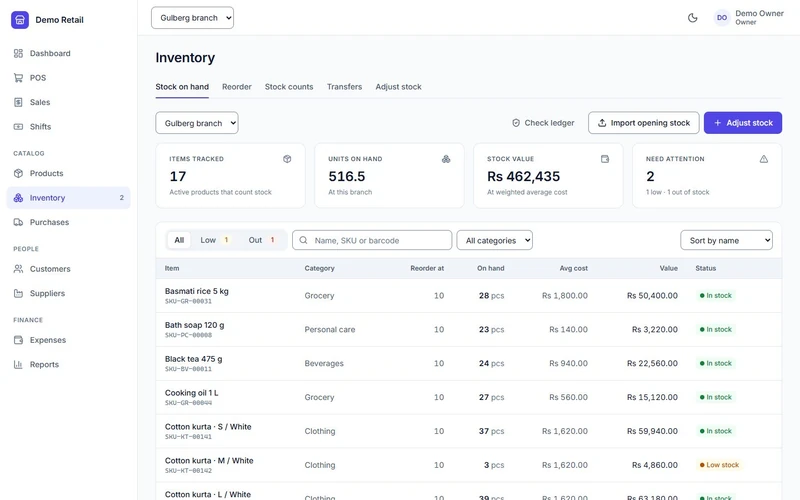
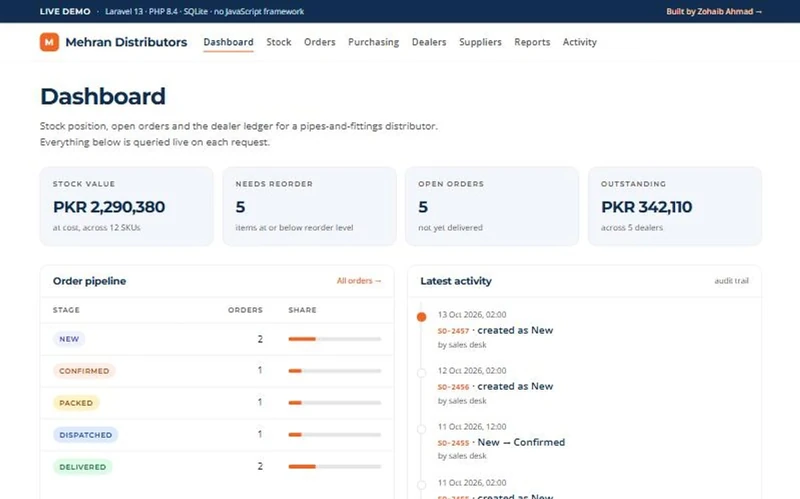
A general point of sale treats every product as one row with one price and one stock number. That works for a grocery shop. It falls apart in a clothing or shoe shop, where one design is really twenty products: five sizes in four colours, each with its own stock.
Here is what to look for if you sell clothes, shoes or anything else that comes in sizes and colours.
1. Every size and colour is its own item
The kurta in medium and the kurta in large are not the same thing on your shelf. If your system only knows "Kurta, 14 in stock", you cannot answer the question every customer asks: do you have it in my size?
A clothing POS keeps one product with variants: the design, price and description entered once, and each size and colour with its own stock count and its own barcode. You see at a glance that medium is sold out and large has six left.
2. Barcode labels you can print yourself
Most clothing arrives without barcodes, or with the supplier's codes that mean nothing to your system. You need to print your own labels with the item, size, colour and price, so the cashier scans instead of typing. Typing is where wrong prices and wrong sizes come from.
3. Exchanges that keep the books straight
"Wrong size, can I swap it?" is the most common thing a clothing cashier hears. A good POS records an exchange as one return and one sale in a single step: the medium goes back into stock, the large comes out, and any price difference is charged or refunded. Without that, the cashier improvises, the stock drifts, and the day's cash doesn't match.
4. Stock in every branch
If you have more than one shop, you need to see stock per branch, and move it between them. When a customer at one branch wants a size that only the other branch has, the cashier should be able to check in seconds, not phone around.
5. Season-end without the guesswork
Clothing has seasons. At the end of one you need to know what is left, in which sizes, in which branch, so you can mark it down or move it. That is a two-minute report in a proper system, and a weekend of counting without one.
6. Staff who can sell but not see everything
Cashiers need to sell, return and exchange. They usually should not see cost prices, profit or other branches' figures. Look for roles and permissions, and an audit log that shows who did what, so a missing item or an unexplained refund can be traced.
Questions to ask before you buy
- Can one design have sizes and colours, each with its own stock and barcode?
- Can I print my own barcode labels?
- How does an exchange work at the till, step by step?
- Can I see and transfer stock between branches?
- Can I stop cashiers from seeing cost and profit?
What we built
Tilly POS was built for this: every size and colour with its own barcode and stock, printed labels, wrong-size returns that keep the books straight, stock in every branch, and roles with an audit log nobody can edit. Plans start at PKR 2,999 a month for one shop, with a 14-day free trial; prices are written down.
The quickest way to judge it is to try it: open the live demo, sell something, return it, and look at the stock. No sign-up needed.